Medical Imaging, Computation, and Artificial Intelligence

A long-form academic overview of contemporary imaging modalities, image reconstruction, computational analysis, and the transition from task-specific deep learning systems to foundation models in radiology.

Medical imaging as a quantitative measurement system

Medical imaging is best understood not merely as visual documentation, but as a family of physical measurement systems that convert tissue properties into spatially organized data. Computed tomography estimates X-ray attenuation and reconstructs cross-sectional anatomy from projection measurements. Magnetic resonance imaging samples proton behavior under magnetic fields and radiofrequency excitation, producing rich soft-tissue contrast through sequence design. Ultrasound converts acoustic reflection and Doppler shift into real-time structural and hemodynamic information. Nuclear medicine, including PET and SPECT, measures tracer distribution and therefore captures metabolism, receptor expression, perfusion, or other functional processes that may precede visible anatomical change.

This diversity is clinically valuable because disease is multidimensional. A tumor, inflammatory process, vascular lesion, or degenerative disorder may present different signatures across anatomy, diffusion, perfusion, metabolism, and longitudinal change. Modern radiology therefore operates as an evidence-integration discipline: images are interpreted in relation to acquisition protocol, scanner physics, previous examinations, laboratory data, clinical history, and the probability structure of disease. The same pixel pattern may have different meaning under different protocols or patient contexts, which is why computational imaging systems must be evaluated as part of a clinical workflow rather than as isolated image classifiers.

From acquisition protocol to interpretable image volume

The first computational layer in medical imaging is formed before artificial intelligence enters the pipeline. Acquisition parameters determine the signal-to-noise ratio, spatial resolution, temporal resolution, radiation dose, contrast timing, and artifact profile of the final study. In CT, reconstruction algorithms transform projection data into Hounsfield-unit volumes whose interpretability depends on calibration, kernel selection, slice thickness, and dose management. In MRI, pulse sequence design determines whether tissue contrast emphasizes T1 relaxation, T2 relaxation, diffusion restriction, susceptibility, perfusion, or functional activation. In ultrasound, probe frequency, beamforming, gain, and operator technique influence both image quality and diagnostic confidence.

After acquisition, imaging data enter a standardized informatics environment. DICOM objects encode image pixels together with metadata describing modality, acquisition geometry, patient orientation, study identifiers, and technical parameters. PACS and vendor-neutral archives provide longitudinal access, while RIS, HIS, and increasingly FHIR-based integrations connect images with orders, reports, and clinical records. This infrastructure is not administrative background; it is the substrate that makes reproducible imaging research, auditability, automated triage, and multi-institutional validation possible.

Conceptual multimodal radiology workstation
AI-generated conceptual image for this website, illustrating scanner-to-workstation multimodal imaging workflow. No patient data or external clinical record is used.

Hybrid imaging and the fusion of anatomy with function

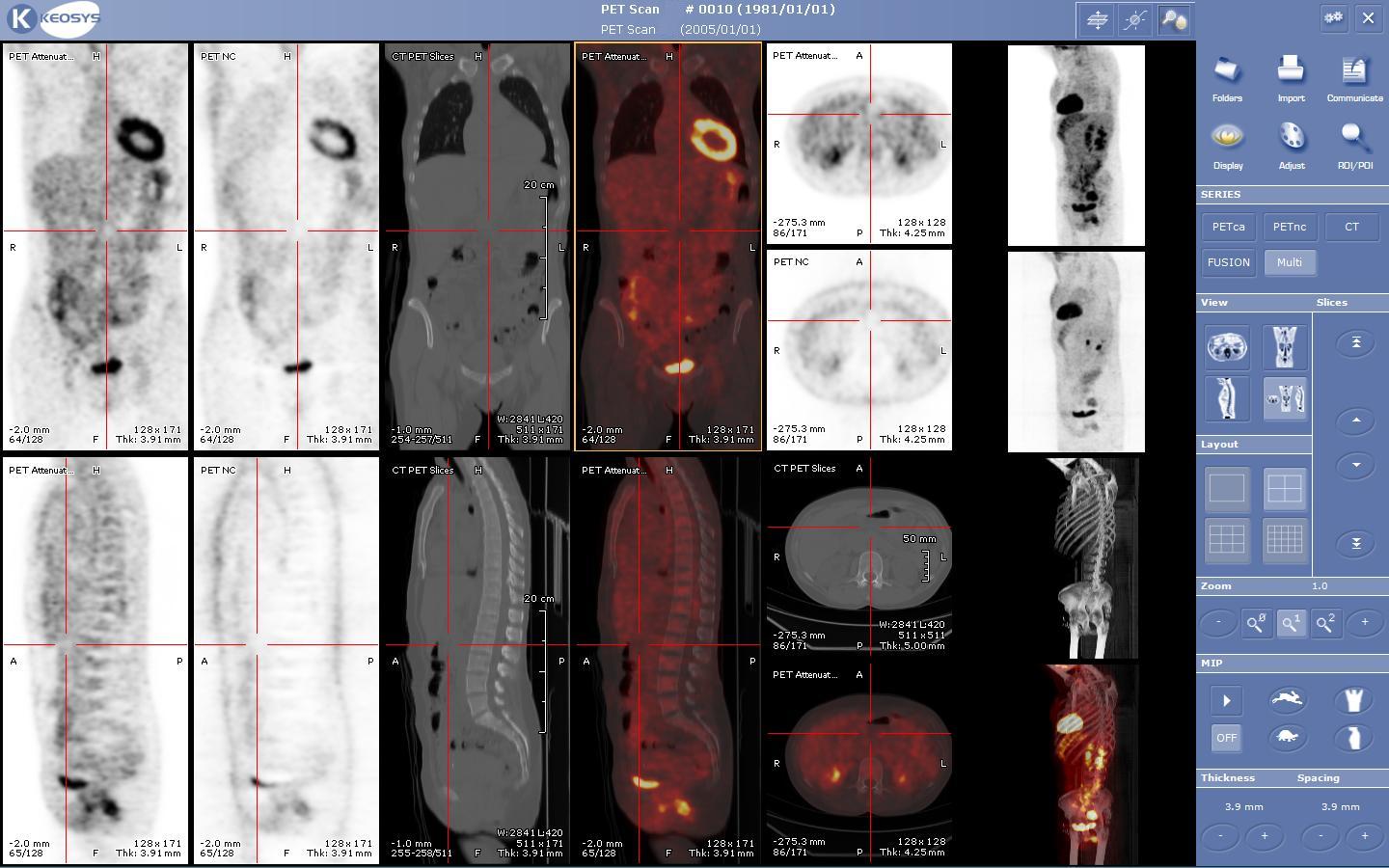
Hybrid imaging illustrates why medical images should be treated as complementary measurements rather than interchangeable pictures. PET/CT combines metabolic information from radiotracer uptake with anatomical localization from CT. This co-registration improves interpretation in oncology, infection, inflammation, and treatment planning because metabolic abnormalities can be located within a structural coordinate system. PET/MR follows the same conceptual logic, pairing molecular or metabolic information with superior soft-tissue contrast and multiparametric MR sequences, although workflow complexity and attenuation correction remain important technical issues.

The computational burden of hybrid imaging is substantial. Registration, attenuation correction, standardized uptake value quantification, respiratory motion management, lesion tracking, and longitudinal comparison all introduce possible sources of bias. For AI systems, this means that the input is rarely a single independent image. A clinically meaningful model may need to reason over multiple series, time points, reconstructed views, quantitative maps, and structured metadata. The most useful systems are therefore those that preserve the relationship between measurement physics and clinical interpretation instead of reducing a study to a disconnected screenshot.

Nuclear medicine PET CT viewer screenshot
Professional image source: Wikimedia Commons, "Viewer medecine nucleaire keosys.JPG", author Mco44, released into the public domain by the copyright holder.

Medical image computing before and after deep learning

Medical image computing traditionally focused on segmentation, registration, shape modeling, atlas construction, image reconstruction, and quantitative feature extraction. These methods remain central because many clinical questions are spatial and longitudinal: where is the lesion, how large is it, how does it relate to surrounding anatomy, and how has it changed? Classical approaches often used handcrafted features, deformable models, statistical atlases, graph cuts, or intensity-based registration. Their strength was interpretability and mathematical control; their weakness was limited robustness under scanner variability, pathology, and diverse anatomy.

Deep learning changed this landscape by learning hierarchical image representations directly from data. U-Net and its many descendants became especially influential because encoder-decoder architectures with skip connections can combine global context with precise spatial localization. This is well suited to organ segmentation, tumor delineation, vessel extraction, dose planning, radiomics preprocessing, and surgical navigation. Later architectures introduced attention mechanisms, transformers, self-supervised pretraining, and state-space models to improve long-range context modeling and computational efficiency for high-resolution two-dimensional and three-dimensional studies.

Example U-Net architecture diagram
Professional diagram source: Wikimedia Commons, "Example architecture of U-Net...", author Mehrdad Yazdani, licensed under CC BY-SA 4.0.

AI in radiology: from narrow classifiers to foundation models

Early imaging AI systems were usually trained for narrow, measurable tasks: lung nodule detection, intracranial hemorrhage triage, mammographic lesion classification, organ segmentation, fracture detection, or image quality control. These systems can be valuable when they reduce delay, standardize measurement, or help prioritize urgent studies. However, narrow task performance does not by itself establish clinical utility. The model must be evaluated against representative patient populations, scanner protocols, disease prevalence, reader behavior, and the downstream decision that the output is intended to influence.

Current research is shifting toward foundation models and multimodal systems. Instead of training a separate model for every organ, modality, and label set, foundation models learn broad representations from large image corpora, image-text pairs, reports, segmentations, or multi-institutional datasets. In radiology, this creates the possibility of models that can support retrieval, report drafting, visual grounding, cross-series comparison, weakly supervised labeling, and adaptation to rare tasks. The central challenge is that clinical imaging is not the same as internet-scale natural image recognition: images are volumetric, protocol-dependent, privacy-constrained, and tightly coupled to clinical context.

Conceptual AI medical image segmentation visualization
AI-generated conceptual image for this website, illustrating segmentation masks, representation learning, and multimodal imaging analysis. No patient data is used.

Clinical validation, governance, and real-world deployment

The decisive question for medical imaging AI is not whether a model can detect statistical signal in a retrospective dataset. The more difficult question is whether the system remains calibrated, useful, and safe across institutions, scanner vendors, reconstruction protocols, acquisition artifacts, patient subgroups, and changes over time. External validation is therefore essential. A model trained on carefully curated academic data may fail when exposed to emergency studies, incomplete metadata, unusual anatomy, portable imaging, pediatric populations, implants, motion artifacts, or different disease prevalence.

Responsible deployment requires a defined intended use, transparent performance reporting, human oversight, monitoring after release, cybersecurity, privacy protection, and an escalation path for failure. Regulatory resources such as the FDA list of AI-enabled medical devices show that medical imaging is one of the most active domains for authorized AI tools, but authorization should not be confused with universal effectiveness. A system can be appropriate for one task, modality, population, and workflow while being inappropriate elsewhere. The most mature approach treats AI as a measured clinical instrument: useful when its operating conditions are known, risky when its assumptions are invisible.

Conceptual medical AI validation and governance workstation
AI-generated conceptual image for this website, representing external validation, human oversight, calibration, and regulatory documentation. No patient data is used.

Academic sources, image credits, and use notes

The written material is a synthesized academic overview rather than medical advice. The discussion draws on high-level radiology AI reviews, segmentation literature, foundation-model surveys, and regulatory resources.